Saudi–Turkey Railway Project: How Transport Corridors Are Reshaping the Investment Landscape in Turkey
At a time when global supply chains are under increasing pressure, transportation projects are no longer مجرد logistical upgrades—they have become strategic tools that reshape economic balances and trade flows between nations.
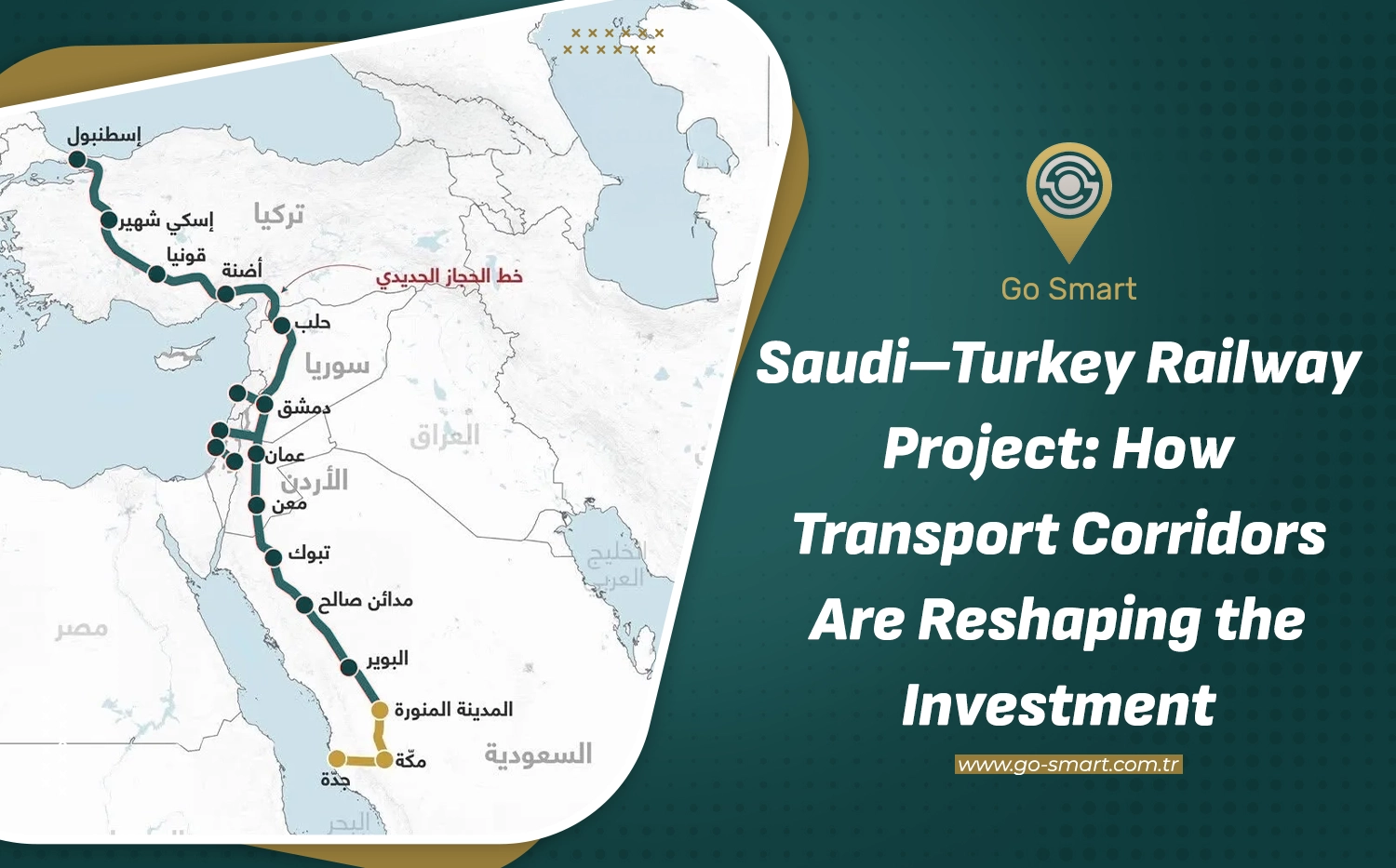
The announcement that the feasibility study for the railway link between Saudi Arabia and Turkey—via Jordan and Syria—is nearing completion by the end of this year fits directly within this shift.
This project is not just a new transport route, but a signal of a deeper transformation in how regional trade is managed, especially amid rising tensions affecting critical maritime corridors.
First: Why Have Supply Chains Become a Strategic Priority?
Global supply chains are the networks that connect production to consumption—from raw materials to finished goods.
Any disruption in this system directly impacts prices, availability of goods, and market stability.
In recent years, these chains have faced multiple shocks:
- The COVID-19 pandemic and production disruptions
- The Russia–Ukraine war and its impact on energy and food
- Rising geopolitical tensions in the Middle East, particularly around the Strait of Hormuz
📌 A significant portion of global oil trade passes through this strait, and any threat to it leads to higher shipping and insurance costs, affecting the global economy as a whole.
This is why countries are increasingly seeking safer land-based alternatives to reduce dependence on vulnerable maritime routes.
Second: The Railway Project… More Than Just a Transport Line
The Saudi–Turkey railway project represents one of the most important of these alternatives.
It connects the Gulf region to Turkey, and from there to Europe, through an integrated land corridor.
Its strategic value lies in:
- Reducing transit time for goods
- Lowering logistics costs
- Minimizing risks tied to maritime disruptions
- Strengthening regional economic integration
📌 In simple terms, this project redistributes trade flows from sea to land.
Third: Turkey… The Region’s Logistical Core
Turkey is not just a transit country—it is a meeting point between continents.
With continued investment in infrastructure, this geographic advantage is turning into real economic power.
Today, Turkey:
- Connects Asia to Europe
- Possesses advanced infrastructure (roads, ports, railways)
- Continues to invest in large-scale transport projects
With this railway initiative, Turkey further strengthens its position as a regional logistics hub capable of absorbing trade flows from the Middle East toward Europe.
Fourth: Historical Context… The Hejaz Railway and the Return of Connectivity
When discussing railway connectivity between Turkey and the Arab world, the historical dimension cannot be ignored.
During the reign of Abdul Hamid II, the Hejaz Railway was constructed, linking Istanbul to the Levant and the Arabian Peninsula, aiming to facilitate movement and strengthen economic and social ties.
However, the railway was destroyed during regional conflicts in the late Ottoman period, particularly during the Arab Revolt, leading to the fragmentation of this strategic connection.
📌 Today, the revival of railway projects signals something deeper than transport:
It represents a modern reconstruction of economic connectivity between Turkey and the Arab world.
Fifth: What Does This Mean for the Economy and Investment?
Improving supply chains has direct economic consequences:
- Stabilizing the flow of goods
- Reducing transportation costs
- Attracting industrial investments
- Strengthening regional trade
This, in turn, enhances the investment environment, as businesses consistently seek locations near efficient logistics corridors.
📌 The closer an investment is to active trade routes, the higher its long-term value.
Sixth: Real Estate… The Silent Beneficiary
In every major infrastructure project, real estate emerges as one of the primary beneficiaries—even if not immediately visible.
As logistics corridors expand:
- Land values near transport routes increase
- New commercial and industrial hubs emerge
- Urban expansion accelerates
In Istanbul, this dynamic is particularly evident in development zones linked to major projects, such as Yenişehir.
📌 Investment at this stage is not based solely on current conditions, but on anticipating future transformation.
Seventh: Turkey as a Safe Investment Haven
In a volatile global environment, investors seek markets that offer:
- Relative stability
- Strong infrastructure
- Strategic positioning
- Long-term growth potential
Turkey delivers this balance, especially as it becomes more integrated into global trade networks.
It is no longer just a local market—it is a regional platform connecting East and West.
Eighth: How Go Smart Interprets These Developments
At Go Smart, such developments are treated as strategic indicators—not just headlines.
The company focuses on:
- Investing in land within development zones tied to infrastructure projects
- Analyzing long-term impacts of large-scale initiatives
- Building investment portfolios based on real, data-driven insights
📌 The goal is to align real estate investment with economic movement—not separate it from it.
Conclusion
The world is rethinking supply chains, and land corridors are returning as strategic alternatives.
The Saudi–Turkey railway project is a step in this direction, reinforcing Turkey’s role as a central hub in global trade.
From an investment perspective, these developments are not just about improving transport—they are about redistributing value and opportunity.
📌 A smart investor doesn’t just follow the news…
They understand what comes next.