


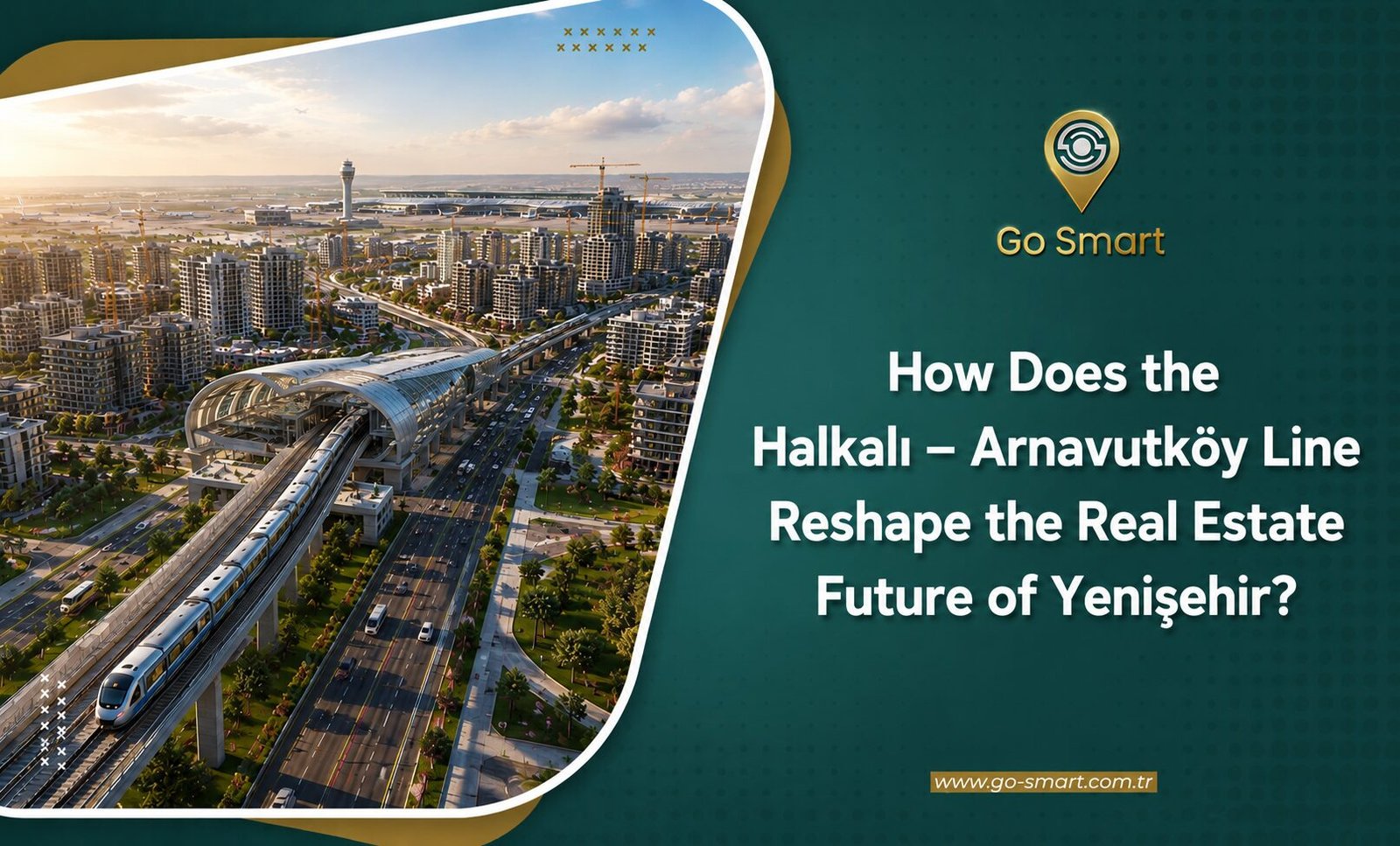
The New Metro in Northern Istanbul: How the Halkalı–Arnavutköy Line Is Reshaping the Future of Yeni Şehir Real Estate
Northern Istanbul is undergoing a structural transformation driven not by market speculation, but by state-led infrastructure expansion. The European side, in particular, is being redefined through major transport corridors that align with long-term urban growth toward the north.
Among these projects, the Halkalı–Arnavutköy metro line stands out as a strategic component of a wider network extending toward Istanbul Airport and beyond. The project is officially planned to be operational around 19 June 2026, according to the Turkish Ministry of Transport and Infrastructure Ministry of Transport and Infrastructure, reflecting its priority status within national mobility planning.
But the real importance of this line is not transportation. It is spatial reorganization.
A Metro Line That Functions as an Urban Reconfiguration Tool
The Halkalı–Arnavutköy line should not be interpreted as a simple connection between districts. It is part of an integrated mobility system designed to restructure how the city expands around Istanbul Airport.
Once operational, the line will strengthen direct and indirect connectivity between:
- Arnavutköy district
- Istanbul Airport zone
- Halkalı interchange hub
- Broader Istanbul metro network
This is not just a reduction in travel time. It is a shift in accessibility hierarchy.
In real estate economics, accessibility is not a convenience factor. It is a pricing mechanism.
The Critical Layer: Yeni Şehir as a Spatial Growth Corridor
The most important dimension of this project is its intersection with the Northern Istanbul expansion zone commonly referred to as Yeni Şehir.
This area is no longer theoretical planning on paper. It is a phased development structure supported by large-scale state projects, including:
- Istanbul Airport mega-hub
- Kanal Istanbul corridor planning
- New road and infrastructure frameworks
- Emerging residential and mixed-use zoning expansions
The metro line introduces something more decisive: integration.
When a metro system connects a developing zone directly into the city’s transport grid, it removes the “distance penalty” that usually suppresses early-stage land value growth.
Real Estate Impact: Why Metro Infrastructure Rewrites Land Value Curves
Globally, metro systems are among the strongest catalysts for land revaluation. The mechanism is consistent:
- Improved accessibility increases demand
- Demand reshapes residential and commercial distribution
- Land value adjusts ahead of actual development density
In Northern Istanbul, this effect is amplified due to three structural conditions:
- The region is still in active urban formation
- Large-scale government infrastructure is already committed
- The area is anchored by Istanbul Airport as a global logistics node
This combination creates a forward-priced market rather than a reactive one.
In other words, value is being priced based on future infrastructure, not current usage.
Arnavutköy and the Shift from Peripheral Zone to Strategic Core
Arnavutköy was historically considered a peripheral district. That classification is no longer valid within the current development model.
The presence of Istanbul Airport has already repositioned the district into a strategic logistics and residential transition zone. The upcoming metro line accelerates this shift by:
- Improving residential attractiveness
- Strengthening connection to commercial centers
- Reducing dependency on private vehicle access
- Increasing feasibility of long-term land holding strategies
This is particularly relevant for land parcels within and around the Yeni Şehir development corridor.
What This Means for Investors
From an investment perspective, infrastructure-driven markets require a different decision framework.
The focus shifts away from current land conditions toward structural indicators such as:
- Proximity to planned transport corridors
- Position relative to state-led development zones
- Integration with long-term zoning plans (İmar status)
- Connectivity to airport and logistics infrastructure
This is why Northern Istanbul behaves differently from traditional urban markets. It is not evolving through organic demand. It is being constructed through coordinated planning layers.
Conclusion
The Halkalı–Arnavutköy metro line is not an isolated transport investment. It is part of a broader urban restructuring strategy in Northern Istanbul.
As it passes through the emerging Yeni Şehir corridor, it reinforces a key reality: Istanbul’s expansion is not random. It is directional, planned, and infrastructure-led.
For real estate markets, this means one thing clearly—value is migrating north, ahead of full urban visibility.
Source: Republic of Türkiye Ministry of Transport and Infrastructure
